Kyle wrote:Ahh, was this in fantasia 2000 by any chance? I never saw it, but I remember seeing one in trailers.
I think he was referring to the ballerina test Glen Keane did for
Rapunzel Unbraided.
http://jimhillmedia.com/blogs/jim_hill/ ... 9/656.aspx
Glen was understandably reluctant to make his directorial debut on a CG film. An animation format that -- in spite of his many years of experience of dealing with CG elements in Disney pictures -- Keane still didn't think that he knew enough about. But then CG Supervisor Kevin Geiger sat down with the veteran animator and laid the challenge out in terms that Glen could grasp and appreciate.
"Kevin said 'If you can do all the things that you do while drawing without using a pencil, are you in?'," Keane explained. "And I said 'Yes.'"
So -- with that goal in mind -- Glen decided to create a test for Disney Feature Animation's CG team. He would first traditionally draw a female ballerina going through a brief dance routine. Then Keane would work with WDFA computer animation technicians to see if it was possible to replicate that figure's movements in CG.
"I was looking to see if they could copy the fluid movement of a human ballerina. And they actually did that," Glen said. "Once I saw that test, I knew that producing 'Rapunzel' the way that I originally envisioned the picture was now possible in CG."
It was shown during a segment of the "CBS Sunday Morning" show a few years back, but I'm having trouble finding images. If I find anything else on it, I'll post it.
*edit*
http://www.awn.com/articles/ichicken-li ... ion/page/6
“So I took the challenge, but said that thing are going to have to be a little different, though. One of the first steps was posing a challenge. I animated by hand something difficult for the computer to do— a ballerina doing little twirls and arabesques. I modeled the figure to see if you could match all of the exaggeration, the subtle twists and turns and graphic shapes in the computer.
“There were a whole lot of things that I discovered about my vocabulary of shapes when I draw, so when I started to break it down, I found that I’m just flexing them all the time. And if we could actually design those shapes and flex them and push them and twist them — make them graphically pleasing—we could come up with something that’s really very different from a traditional CG character. Drawing means that you’ve got to have a lot of flexibility and choices in how you want those shapes to be. As I drew that ballerina by hand, I stretched and broke bones and twisted ankles and made muscles straight when they could’ve been curved or curved when they could’ve been straight.
And then when we put our CG figure in there, she remained consistent all the way through with no aesthetic. She lacked the beauty and the rhythms that I put in the drawing. So we had to write new software code for Maya and other traditional CG tools, which would allow us to stretch and push shapes and design so that we were bringing design back into those forms. And the test came out promisingly. Then when Disney was doing Mickey’s Philharmagic [for Disney World], I reworked the Ariel segment and tried to apply the principles taught by The Nine Old Men: build everything around pleasing golden poses. I concentrated on 20 poses and that worked as well.”
So with Rapunzel Keane is trying to bring drawing into CG by applying basic design principles. He admits that it’s a big leap forward for both character performance and environment. For inspiration, Keane and his animators are referencing a painting by French Rococo artist Jean-Honore Fragonard, The Swing, applying a certain richness that they have never attained in animation before.
*edit*
http://www.siggraph.org/programs/archiv ... -animation
When Keane was first introduced to CG he was skeptical. He didn’t believe that CG could capture the same organic fluidity that he coveted in his hand drawn animations. He decided to conduct a test. He animated by hand 5 seconds of a ballerina gracefully spinning across the dance floor. He played this clip for the audience.
He said he took his ballerina to the CG people and asked what they could do. In the next clip he played a 3D version that wowed the audience. But once you create something in 3D there is nothing keeping you from changing your camera’s viewpoint on the animation and the third clip of the ballerina is what took the audience’s breath away. The same ballerina with the same fluid motion danced across the floor as the camera spun around her ending above as she tilted her face skyward for the finale. We were all ready to drop pencils forever and embrace the wonders of computer graphics.
For Keane, the computer kept entering the equation. It was the obvious direction for where his art should be going. Computer graphics forced him to draw better with more dimension and a better sense of space, and although new and frightening, he like it.
Finally, I found it! I wasn't going to rest until I found an image to show you!
http://animationarchive.net/Future%20Pr ... rt/bal.jpg
*edit*
Here's another picture from that CBS Sunday Morning segment:
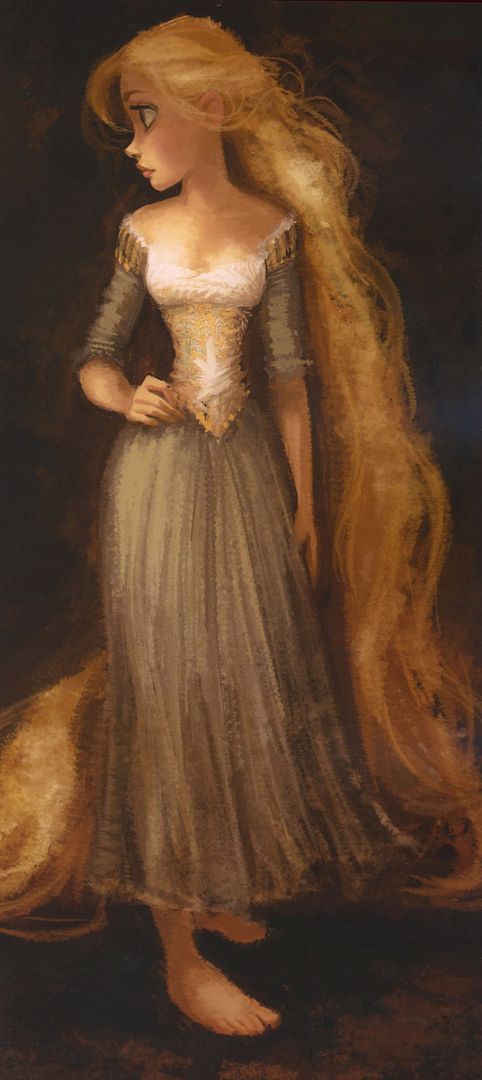
http://animationarchive.net/Future%20Pr ... t/unk1.jpgIt is.. I mean really, that design is very appealing, she is young, quirky and seems full of life. I just hope that they make her look more 2D, I mean why not traditionally animate her and use CG to add texture and some more shadows. I mean really? Why in the world would the studio want it be CG in the first place is what I'm wondering. Disney is the only company who ever truly pulled off hand drawn animation, and it's the only company really that has ever had REAL successful fairy tales, not fantasy, fairy tales. Why not make Walt's 50TH FILM hand drawn.. a tribute to him.. it is the 50th.. and it's Rapunzel.. the one story Walt could never get just right...










 Well, shucks. I'm not amazing- I just have a lot of free time.