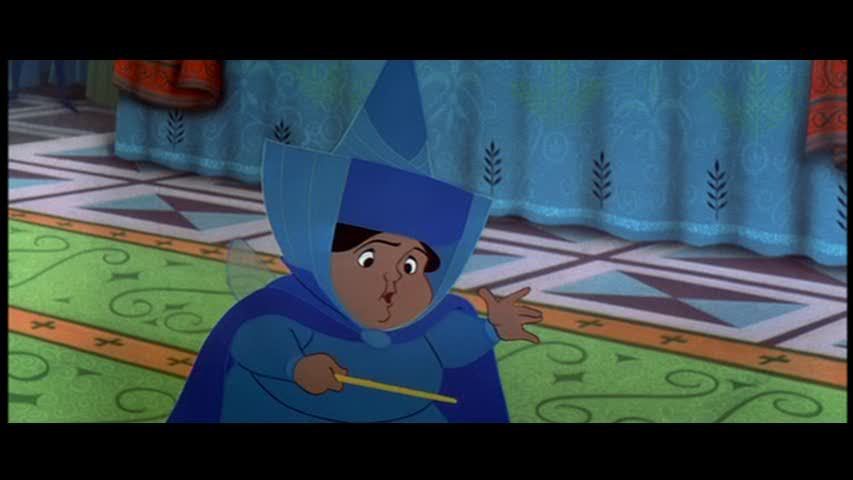
Disney Duster wrote:It really would be extra expensive to pay people to, basically, digitally paint? We've know they digital re-paint, or paint-over, in restorations. We've seen it in Sleeping Beauty's previous DVD restoration feature, and evidenced by screencaps of Cinderella showing one thing being mistakenly colored one way originally, and re-colored to be more correct in the new restoration for the DVD.
But they were "fixing" errors, just like how they "fixed" the disappearing Raccoon in Bambi and the transparent Figaro in Pinocchio.
We can debate if that's right or wrong, but to suggest that they repaint the whole of each frame, frame by frame is just ridiculous. Because they fixed a disappearing raccoon in Bambi, it doesn't logically follow that every single frame's composition was altered does it?
And correct me if I'm wrong, but on the earlier Sleeping Beauty restoration wasn't one of the problems that colours fickered/pulsated due to the inadequency of the source they were using. It would be pretty hard to remove this pulsing without adjusting the colour - and indeed, it still did pulse - especially on the earlier released PAL DVD (as I commented
here in 2003! Way before all this restoration fuss was taking over the forum).
Besides, I'll have to watch it again, but weren't they only "painting" bits from the same frame or previous/subsequent frames over damaged areas in that restoration featurette?
Not only was Sleeping Beauty's (previous) restoration done 10 or more years ago on less technology, but it also had its own unique problems. It's pretty hard, I'm sure you'll admit, to fix fluctuating colours without some form of recolouring/colour management. More importantly - Disney themselves knew it wasn't up to the standard required today and paid for an all-new restoration we see on the Platinum release today.
I think its clear the 1998-ish restoration wasn't a proper job. I doubt it was from the original negatives for example (due to the pulsing colours). I'm sure it was vastly superior to what they could have done from a photochemical restoration from a pulsating source, but at the same time, it wasn't a complete overhaul direct from the negatives. It was also the first (or one of the first) all digital restorations. You can't expect new techniques to hit the ground running.
Just follow the link below to see how digital restoration has improved since 1998. People wouldn't spent the time and effort developing these techniques and formulae unless there was a need. (Although not all are directly related to film restoration).
http://www.ima.umn.edu/2005-2006/W2.6-1 ... racts.html
Something else you have to remember is even the machines for scanning/playing old film/negatives have evolved over the past decade. Developments with wet gate scanning mean that the original is much less likely to be scratched or damaged.
I don't think this site is correct, but they claim to be the only wet gate scanning facility in North America.
http://www.ivchd.com/services.shtml
Digital Intermediate
Digital Intermediate Finishing 4K, 2K, or HD, Color Correction, Conforming, Titling
Dual Sync Dailies HD (4:4:4 or 4:2:2) and SD with Keykode and timecode.
Film Scanning (4K/2K/HD), including the only wet-gate film scanning in North America
35mm Film Recording, and 35mm printing.
If correct - or even semi-correct (they probably mean the only wet gate 2k+ scanning), but if that's the case, I doubt there were many - if any - wet gate scanners for lower resolution copies in 1998!
The previous restorations never/rarely used the original negatives or even the original positive print as the base of the restoration - the risk of damage would be much higher.
Thus the 1998 restoration of Sleeping Beauty probably had to be from a film print which was suffering from the beginnings of colour fading.
And the restorers had to do the best they could with the source they had. That's why I get annoyed - people who work on these restorations are not miracle workers - they constantly do their best and each restoration takes months - not just physically but also in research and investigation.