Cel paint used by Disney

All topics relating to Disney-branded content.
Post Reply
User avatar
Rumpelstiltskin
Anniversary Edition
Posts: 1306
Joined: Thu Jun 29, 2006 9:05 pm
Gender: Male

Cel paint used by Disney

Post by Rumpelstiltskin »

Anyone who have noticed any differences in colors between Oliver & Company and The Little Mermaid on one hand, and all other cel animated features from Disney? Or perhaps the digital restorations have erased potential differences.

Found this info on the net:

https://rockinmama.net/the-ink-and-pain ... n-studios/
At one time, all paints were custom-made at the studio lab, but the gum-based resin paint used took up to 8 hours to dry. A fast-drying paint was used for the first time in the production of Oliver & Company.
And from a 1995 article:
http://resources.conservation-us.org/pm ... gallo.html
On July 31st, 1939 EMILIO BIANCHI started his career at Disney as a Chemist in the Paint Lab. Emilio began by mixing gouache paints and in time became the Paint Lab Supervisor until he retired in 1978.

The recipe for “BAMBI” “1942” is considerably drier and applied thinner than the paint which was used for “PETER PAN” “1953”. A significant change in paint chemistry occurs between the productions of “CINDERELLA” “1950” and “ALICE IN WONDERLAND” “1951”. This paint is moist and applied with a heavier coat. The steady use of this recipe continues until “THE GREAT MOUSE DETECTIVE” “1986”. “OLIVER AND COMPANY” “1988” marks the first time “Cel Vinyl” paints were made at the studio but soon its manufacture was abandoned for paints bought from local vendors. “Cel Vinyl” paints were used to create “cel” art for the productions of “WHO'S AFRAID OF ROGER RABBIT?” “1988” “whose “cel” art was made in England” and for “THE LITTLE MERMAID” “1989”. A proprietary computer generated coloring system was developed for translating animation pencil drawings into color and was used for “THE RESCUERS DOWN UNDER” “1990”. Its use has continued with each subsequent animated feature film the studio has released. The making of “cels” as production art has been discontinued with the exception of Disney Television which still employs the traditional use of xerographic line transfer and cel vinyl paints on registered tri-acetate sheets.
(I assume also the use of cel animation in Disney Television ceased a long time ago)

It's clearly a reason why the 80s has been called the transition era in Disney animation. As pointed it in a previous post I think; The Fox and the Hound was the first feature made by a new generation of animators. The Black Cauldron and all later features use CGI to various degrees (including The Prince and the Pauper, the only featurette to combine cels and CGI), and experimented with the APT-process. A new sound library replaced the old one. And again; acrylic paint replaced the gouache paint. The Little Mermaid was shot on color negative (the other features used the Successive Exposure method, which was essential the same as the Technicolor process except it was specialized for animation).
Then CAPS came and cel animation was history.
User avatar
Jules
Diamond Edition
Posts: 4629
Joined: Sun Mar 12, 2006 9:20 am
Gender: Male
Location: Malta, Europe
Contact:

Re: Cel paint used by Disney

Post by Jules »

Rumple wrote:The Little Mermaid was shot on color negative (the other features used the Successive Exposure method, which was essential the same as the Technicolor process except it was specialized for animation).
This is very interesting. I wonder if shooting Mermaid on colour negative as opposed to successive exposure affected the final look of the film. I've long thought Mermaid looked a bit soft and fuzzy compared to previous features like Cauldron, GMD and Oliver.
User avatar
Farerb
Signature Collection
Posts: 5213
Joined: Sat May 19, 2018 2:09 pm

Re: Cel paint used by Disney

Post by Farerb »

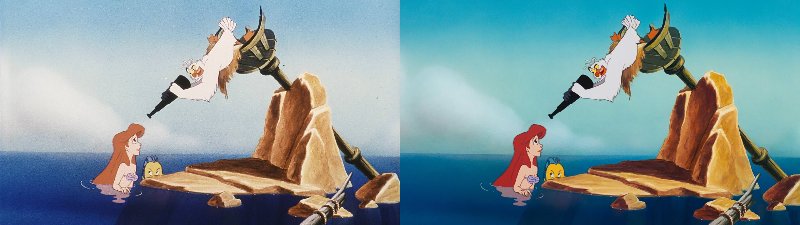
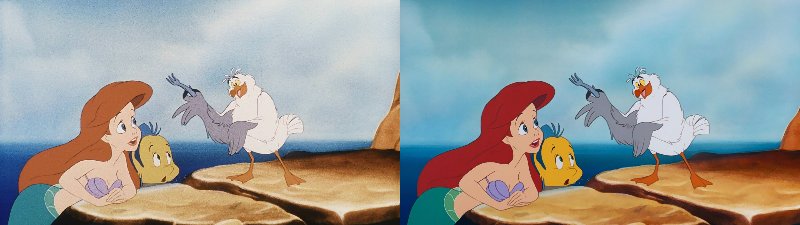
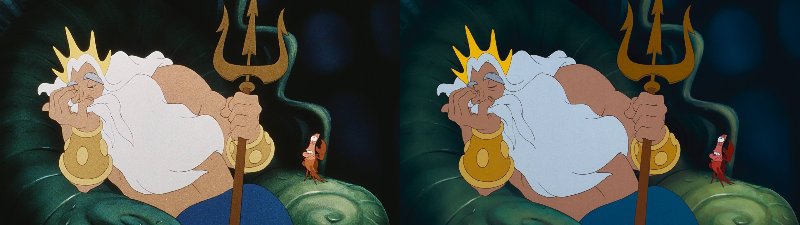
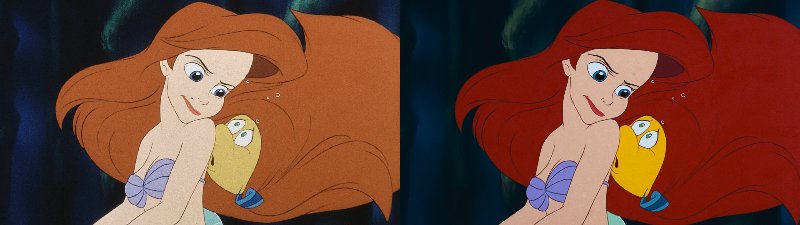
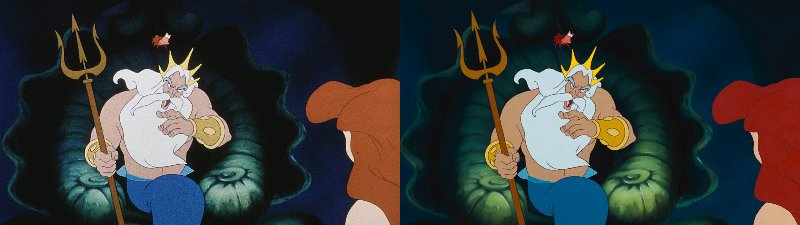
Especially in the film print which is more dull than the Blu-ray:
Image
Image
Image
Image
Image
Image
User avatar
Jules
Diamond Edition
Posts: 4629
Joined: Sun Mar 12, 2006 9:20 am
Gender: Male
Location: Malta, Europe
Contact:

Re: Cel paint used by Disney

Post by Jules »

Whoa! Did Mermaid really look that faded on its original 1989 cinema release? Was it intentional?

Any idea when the 35mm scans on the left were made? If they are recent, could they have been sourced from an aged and faded print?
User avatar
Farerb
Signature Collection
Posts: 5213
Joined: Sat May 19, 2018 2:09 pm

Re: Cel paint used by Disney

Post by Farerb »

Jules wrote:Whoa! Did Mermaid really look that faded on its original 1989 cinema release? Was it intentional?

Any idea when the 35mm scans on the left were made? If they are recent, could they have been sourced from an aged and faded print?
I think it's a German rerelease from 1997.
User avatar
Rumpelstiltskin
Anniversary Edition
Posts: 1306
Joined: Thu Jun 29, 2006 9:05 pm
Gender: Male

Re: Cel paint used by Disney

Post by Rumpelstiltskin »

Jules wrote:This is very interesting. I wonder if shooting Mermaid on colour negative as opposed to successive exposure affected the final look of the film. I've long thought Mermaid looked a bit soft and fuzzy compared to previous features like Cauldron, GMD and Oliver.
Mentioned in a previous post, but it doesn't hurt to post it again:

https://www.thedigitalbits.com/site_arc ... 01308.html
RAH: I understand that at a certain point, there was a move from SE to standard Eastman color negative. When did that occur, and did it remain that way for any length of time?

TG: The Little Mermaid (1989) was shot on color negative primarily as a financial consideration.

By using EK color negative, you could far more easily farm out the work to different animation facilities and use multiple labs. There were some issues associated with Mermaid and the use of color negative so it was a one time only decision and the Studio went back to creating SE negatives for Beauty and the Beast and so on.
Not sure why they are mentioning Beauty and the Best, since CAPS had replaced cameras by then. Maybe for storing negatives in the vault or something.

Also found this on another board:
https://originaltrilogy.com/topic/The-L ... 506/page/3
In 1997 Disney scanned in the original 1989 final production negative used as the basis to print the theatrical release from and then touched it all up in computers and then put it back to film. So I’m not sure we can really take a 1998 print as giving us the true original 1989 look (where to find a 1989 reel though, I have no clue sadly, I also wonder if some of them would not be a bit faded by now, I forget around what time the typical print strated becoming a bit more color fast).
Just curious how they shot the theatrical shorts and TV-animation during this period. What TV is concerned, I'm guessing they went for the cheapest option.
User avatar
Farerb
Signature Collection
Posts: 5213
Joined: Sat May 19, 2018 2:09 pm

Re: Cel paint used by Disney

Post by Farerb »

CAPS films were still put on negatives cause film prints were still the only way to screen them at cinemas in the 90's.
User avatar
Jules
Diamond Edition
Posts: 4629
Joined: Sun Mar 12, 2006 9:20 am
Gender: Male
Location: Malta, Europe
Contact:

Re: Cel paint used by Disney

Post by Jules »

farerb wrote:CAPS films were still put on negatives cause film prints were still the only way to screen them at cinemas in the 90's.
True, but weren't those transferred to film using a Laser Film Recorder? How would successive exposure have worked in this context?
User avatar
Farerb
Signature Collection
Posts: 5213
Joined: Sat May 19, 2018 2:09 pm

Re: Cel paint used by Disney

Post by Farerb »

Jules wrote:
farerb wrote:CAPS films were still put on negatives cause film prints were still the only way to screen them at cinemas in the 90's.
True, but weren't those transferred to film using a Laser Film Recorder? How would successive exposure have worked in this context?
I don't know, but I think it was something like that.
User avatar
Rumpelstiltskin
Anniversary Edition
Posts: 1306
Joined: Thu Jun 29, 2006 9:05 pm
Gender: Male

Re: Cel paint used by Disney

Post by Rumpelstiltskin »

I assumed they had a way to transfer the images from CAPS movies directly to film. Even if they claim they used the successive exposure process, I can't have been a direct copy of the way the photographed traditional animation cels. Unless they were printed out first.

Found this patent from Disney, dating back to 1993/1994. So it is obviously not the ATP-process: https://patents.google.com/patent/US5548317
It's called "cel production by thermal transfer processes".

(Imdb also lists an employee named Albert Francis Moore as xerox processor on The Rescuers Down Under, Beauty and the Beast, and Aladdin. Not sure why xerox was involved in these productions.)

Regarding the successive exposure process, I wonder if it was ever used on stop-motion movies. Wish Disney had tested it on The Nightmare Before Christmas.

A couple more facts that can be added about the transition era; The Black Cauldron was as many are aware the first animated movie since Sleeping Beauty shot on 70mm film, and for The Great Mouse Detective the layouts were done with computers and the pencil tests used video cameras rather than taking pictures of the drawings with traditional film. Also the fact that they had to move out from the old animation building and into a warehouse was a sign that things were changing at the studio.
After The Rescuers Down Under, the evolution of animation has been restricted to soft- and hardware. Which is probably one of the reasons why some are drawn to the more traditional stop-motion animation.
Post Reply