I'd really need a whole book to really put it all into words, but broadly I'd say that Frozen II does what all great movies do: it finds clear ways to phrase complicated emotions.
I happened to view the film again last year when I was doing my first watch through The Sopranos, right after the episode where Dr. Melfi tells Tony something along the lines of "Once we've stopped putting out fires, that's when we get to find out who we really are," and that's ultimately what this film is for Elsa. She's done the hard work of breaking out of her "conceal don't feel" shell, now she gets to find out what she can do and what she's about.
And there's a lot here that I just find internally rewarding as well. One of my favorite underrated moments in the entire film is the first time Elsa sees the fire spirit after it's defused, and suddenly she's just a person having a conversation with a small creature of the forest. This is like a rite of passage for the Disney Princess, but this is the first time she's been able to let that part of her shine, and I love seeing how Elsa brings her unique spin to this in a way that recalls the likes of Ariel and Snow White but also feels specific to her.

That sounds like a really straightforward hero's journey, but a part of what makes it so next-level is the way that it phrases this scenario in such a way that we're not totally sure that we want Elsa to achieve this, which is where Anna's story really comes into play. She's scared that if Elsa does what she has set out to do, she will lose her, either because she will drift away to more important things or she'll be taken out by some cataclysm of suitably mythic proportions. The whole last film was just a study in how desperate Anna was to feel loved, and so we understand the specific implications this has for her. Moreover, we understand it because the insecurity that we might lose a person on our way to self-actualizing is a recognizable experience. Complex emotion, but when you hear it reflected back to you like this, it checks out, as in all great movies.
And all the film's individual pieces connect back to this basic tension: will Elsa be able to fulfill this grand destiny set for her, and what will that mean for that happy ending we worked so hard for back in 2013? Characters like Kristoff and Olaf have their own storylines, yes, but you can still see how being dragged along on this flight with Elsa has had clear bearings on these conversations. Olaf, for example, remarks late in the film that Anna told him some things never change, but ever since then, "everything's done nothing
but change," which is a feeling Anna can definitely relate to. They're all asking the same question, just phrased uniquely according to each of them. That is a pillar of strong storytelling.
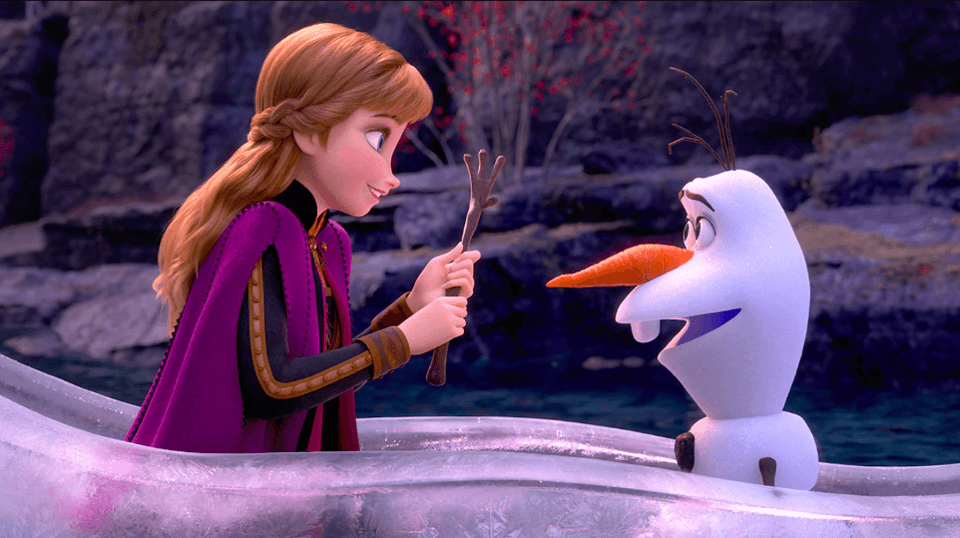
I hear people all the time falling back on lines like, "there's just no story," or "you can just tell they had no idea what they wanted with this, and this was all just done for money," and ... I just don't really know what to make of those arguments because that's just never been how the film read to me. Like, I know what setup/payoff is, I know what three-act structure, I know about all that, and they all check out just fine to me. I see the motivations within the finished film and how it ends up landing in the places it does. It doesn't feel like they were just putting out whatever in order to make a sequel to their highest grossing film. So I can't help but feel like there's a little more going on here than just straightforward film analysis.
My other thought is that excellence within film looks different depending the needs of the specific film, especially along the lines of genre and medium. A lot of people try to grade the film like a Chris Nolan sci-fi piece or something where the selling point is having a really tight cause-effect link, but Frozen II isn't that. It's an animated musical fairytale. Its payoffs are all emotion based. As with the last film, a lot of people wanted to default to, "Nobody actually likes the
story, they just like the
music," and I'm just like ... but that IS the story. The audience tearing up when Elsa's mother tells her, "You are the one you've been waiting for," THAT is the story. That is what the film has been building up to, and pulling it off is a lot more sophisticated than just pure sentimental imagery. Four years on, that's what they tried with WISH, and the difference between the films feels discernible.
Again, I'd need a much larger space and much more time to trace out everything. I think there's also a lot going on with how they play with genre and character, but that's sort of the crust of my thesis.
 The Animation looks pretty, especially the Waterhorse fight scene and I like Annas overall character design here but nothing more in my opinion, but im really curious of your opinion
 While I still hold my Position, thats actually a great way to show some strenghts the movie wanted to showcase, like Elsa embracing and helpfully utelizing her powers. Im probably gonna watch the movie again this or next year to build on the "3 years later" timejump, maybe my views will kinda soften on that.
  Thanks for sharing!